Baseball and Puerto Rico: Fields of Identity and Diaspora
By William-Sebastian Gil
Introduction
When I first decided to work with baseball cards, I expected the project to feel light and nostalgic. These small printed objects have always existed in my mind as casual collectibles that sit in boxes or binders which are often forgotten to a normal fan of the sport. Once I selected three cards from different periods and placed them beside a fourth card that I burned and distorted, I began to understand how much more they contain. They hold historical weight, visual meaning, and emotional charge. They reveal how Puerto Ricans have appeared within United States culture across time. They also reveal how unstable these appearances truly are. My chosen images include a Roberto Clemente card that reflects the aesthetics of the late twentieth century, a Carlos Delgado card from the early years of the twenty first century, and a modern Francisco Lindor card that belongs to today’s highly polished sports economy. The final image is the one I altered through burning. The ink melted into organic shapes that look strangely similar to biological tissue. The moment I saw it, I felt something shift. The card did not behave like a printed object anymore. It felt alive in a way I did not expect.
This combination of images allowed me to think about Puerto Rican identity across historical moments (Masuka 2022). It also allowed me to think about the role of photographic surfaces and how time interacts with images. My material experiment opened a space to reflect on the fragility of representation and on the surprising ways that surfaces can transform under pressure. This essay explores each image through historical context, formal analysis, and material experimentation. It also considers how these photographs relate to Puerto Rico’s unfolding present moment. Together, they form a conversation about time, memory, and the unstable nature of representation.
Historical and Contextual Analysis
Roberto Clemente and the legacy of the 1970s
The Roberto Clemente card stands at the beginning of the visual and historical sequence. Although the card was printed after his death, it carries the visual spirit of the late 1970s and 1980s. Clemente became a powerful symbol for Puerto Ricans, not only because of his achievements as an athlete but also because of his humanitarian work and the story of his final flight. His plane crashed on the way to deliver aid to Nicaragua in 1972. The tragedy occurred during a time when Puerto Rico was undergoing major changes. The industrialization effort known as Operation Bootstrap had transformed the island’s economy but also contributed to large waves of migration to the mainland. The decade that followed brought uncertainty, adjustment, and growing financial dependence on the United States (Brink 2024).
Clemente therefore emerged as a figure who carried more than athletic success. He became a representation of Puerto Rican dignity and generosity at a time when the island was negotiating its political and cultural identity within a difficult economic landscape. The card reflects this. It uses painted textures and bold color to present him almost like a heroic figure. The Puerto Rican flag behind him asserts a sense of national pride. At the same time, the card belongs to a commercial industry based in the United States, which means that Clemente’s image travels within a system that has often shaped Puerto Rico’s story from the outside. The tension between national pride and commercial circulation becomes part of the meaning of the card.
Carlos Delgado and the early two thousands
The Carlos Delgado card belongs to a very different moment. In the early years of the twenty-first century, Puerto Rico was beginning to feel the consequences of the repeal of Section 936, the federal tax incentive that had supported much of its manufacturing economy. Factories closed, unemployment increased, and the groundwork was laid for the debt crisis that later dominated the island’s political life. Delgado played in Major League Baseball during this gradual unraveling, and he became known not only for his athletic ability but also for his quiet political stance. He famously did not stand for the performance of God Bless America during the Iraq War, which was a controversial and bold act at the time (Rhoden 2004).
The Delgado card carries a sense of realism. The photograph captures him mid swing with a blurred stadium behind him. The frame is clean and modern, and the image feels grounded in the physical world. This clarity reflects the historical moment. Puerto Rico was entering a period when its economic challenges were becoming harder to ignore. The card mirrors this shift away from myth toward realism. It shows Delgado as a professional athlete rather than as a symbolic figure.
Francisco Lindor and the present moment
The Francisco Lindor card represents the contemporary era. It is visually intense, almost futuristic. The background is filled with glowing geometric shapes and metallic textures. The lighting is dramatic, and the card is designed to grab attention instantly. This visual language belongs to a sports industry that now markets athletes as global celebrities. Lindor himself is widely recognized across baseball and beyond.
The historical context surrounding this card is significant. Puerto Rico in the 2010’s and 2020’s has been shaped by the debt crisis, the imposition of the PROMESA fiscal board, and the devastation caused by Hurricane Maria. These events produced massive migration, with many Puerto Ricans relocating to the mainland in search of stability. The Lindor card enters this cultural landscape as a symbol of Puerto Rican excellence and visibility. Yet the polished and hyper modern quality of the card can also create a distance from the lived experiences of the island. It promotes spectacle at a time when Puerto Rico continues to navigate political, environmental, and economic vulnerability. The tension between celebration and crisis becomes visible in the image.
Formal Analysis
Clemente’s card
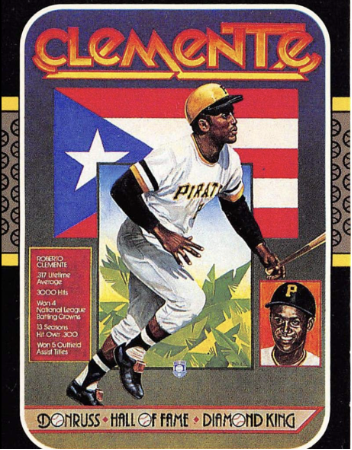
Donruss Roberto Clemente Baseball Card, no. 612. 1987 Donruss Baseball Set. Donruss, 1987.
The Clemente card uses illustration rather than straightforward photography. The colors are warm and nostalgic. The Puerto Rican flag behind him acts almost like a halo, placing him in a heroic position. The typography is ornate and confident. Clemente appears timeless, suspended in a space that belongs more to collective memory than to a specific moment.
Delgado’s card

Topps Carlos Delgado Baseball Card, no. 125. 2006 Topps Series 1. Topps, 2006.
The Delgado card prioritizes clarity and realism. The action shot captures athletic movement rather than symbolism. The colors are natural, and the background is softly blurred. This card shows Delgado as a working athlete, someone who occupies the everyday rhythm of the sport. It does not attempt to mythologize him. It simply records a moment.
Lindor’s card
Topps Francisco Lindor Baseball Card, no. SMLB-28. 2023 Topps Stars of the MLB Series. Topps, 2023.
The Lindor card abandons realism almost completely. The background looks to be a digital design. The colors are vibrant and intense and unnatural. The entire surface is engineered for impact. This card is not just a photograph. It is an object of spectacle. It communicates energy, glamour, and commercial appeal.
Material Experimentation: Collage of all three images
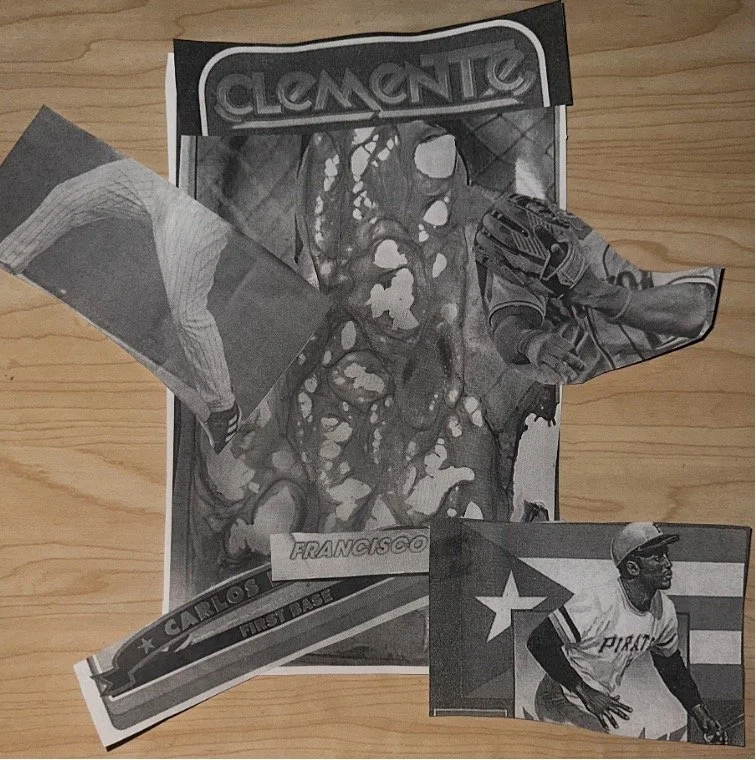
When I created the collage, I was building a single figure out of fragments from three different players. The arms, legs, and nameplates belong to different eras, yet they come together to form one composite body. This construction felt meaningful because no individual athlete can capture the story of Puerto Rican baseball or the experience of the diaspora. Puerto Rican identity is not contained in a single narrative. It is built from many people who have lived through different historical moments and who have carried Puerto Rico into the public eye in distinct ways. By cutting and pasting these images, I was not only assembling a new player. I was acknowledging that representation emerges from a collective history.
The collage positions the burned card at the center. This gives the piece a living core, almost like an organ that holds the memories of all the players around it. The tissue-like patterns of the burned image create a sense that the composite figure has a heartbeat. It suggests that Puerto Rican identity is not static. It grows, transforms, and absorbs the experiences of each generation. The limbs from different athletes do not match perfectly, but this mismatch becomes part of the meaning. The diaspora itself is made from pieces that do not always align neatly. People from different periods, born in different places, shaped by different events, still come together to form a shared sense of belonging.
The collage also challenges the idea that time moves in a straight line. The Clemente fragment sits next to the Lindor fragment. Delgado’s nameplate cuts across the burned surface that has lost its original form. These images overlap in a way that ignores chronological order. Instead of a timeline, the collage creates a single moment where all these histories meet. Puerto Rican identity becomes a layered space rather than a sequence of separate events. The collage suggests that the past does not stay in the past. It is carried into the present through memory, influence, and cultural presence. I also chose to print in black and white when creating the collage so that the designs on the cards don’t overshadow one another. This choice leads us to truly appreciate the unity that all of these cards have together, even when they are cut up and placed in different contexts.
By assembling a player from players, the collage honors the collective labor that has shaped Puerto Rican visibility in the world of baseball. Clemente, Delgado, and Lindor each represent different stages of the island’s story, yet none of them alone can express the full complexity of that story. The collage recognizes this and transforms it into a visual argument. Identity is not singular. It is made from many hands, many bodies, many moments, and many stories. The composite figure stands for that shared construction and speaks to the way the diaspora builds itself across generations.
Material Experimentation: Burning the Image
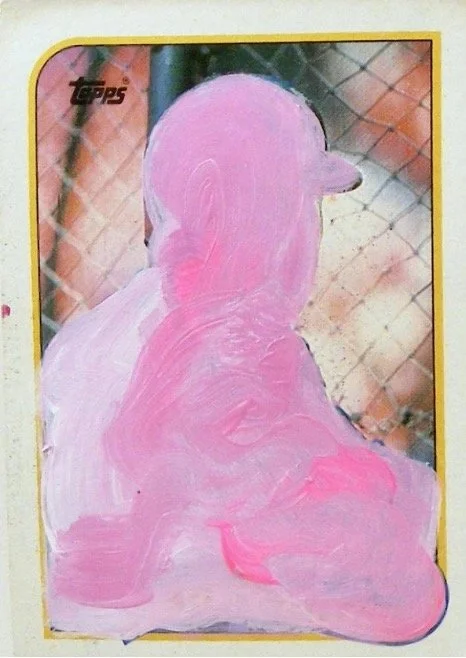
Original Image: Glorimar Garcia, Beisbol Card Series
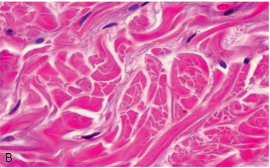
Loose Connective Tissue: Corden et. al., Cell Biology, 2017
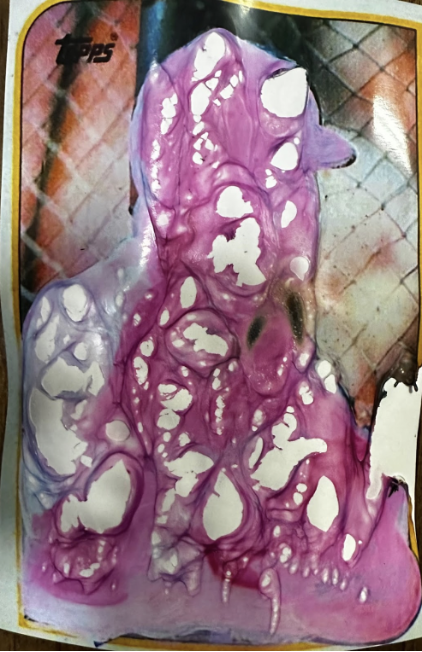
The most surprising shift in my project happened when I burned the fourth card. I expected the surface to darken or warp, but I did not anticipate the ink melting into patterns that resemble living tissue. The surface grew soft in places, and the colors blended into deep pink and purple shapes. The athlete on the card became almost invisible as only faint outlines remained.
This transformation made me reflect on the relationship between time and photographic surfaces. A sports card is supposed to preserve a moment, as it freezes an athlete in a specific pose and converts that instant into a collectible object, which creates a stable form of memory. By burning the card disrupted this expectation, the surface became unpredictable rather than preserving a specific moment in time. The ink pooled, separated, and formed irregular cavities. The image no longer functioned as a record. It turned into something new and unfamiliar.
The most surprising part was the sense of life that emerged. The melted areas looked organic, almost like strands of muscle or a stained histology slide. The transformation did not feel like destruction. The card seemed to move out of its original temporal frame and into the present moment. It no longer represented a past event. It existed as an object that demanded attention right now.
This experience helped me think about Puerto Rico and its shifting relationship to representation. The island is often shown through simplified images that flatten its complexity. People encounter the same predictable visuals: beaches, flags, storms, celebrations. These images can feel fixed, even when the lived reality is changing rapidly. Burning the card reminded me of how fragile and misleading fixed images can be. Once the surface melts, the story changes. The card becomes a metaphor for the island’s political and cultural position. Pressures accumulate, surfaces crack, and yet new forms appear.
The burned card also challenged the idea that photographs are stable. In reality, they are physical objects with inks, coatings, and layers that respond to heat and moisture. When those layers shift, the meaning shifts with them. This realization made the project feel more intimate. I was not only analyzing images, I was touching them, altering them, and discovering what happens when a surface refuses to function as it was intended.
Present Day Inquiry
Placing the burned card next to the others helped me understand how these images speak to the present. Puerto Rico continues to navigate the long term effects of austerity measures, environmental vulnerability, and migration. These challenges accumulate across time and create a sense of ongoing uncertainty. The Clemente, Delgado, and Lindor cards show three different stages of Puerto Rican visibility in the United States. The burned card interrupts this timeline by refusing to remain in the past. It forces the viewer to confront instability. It asks us to consider what happens when representation breaks down.
In today’s world, images circulate quickly and often without context. Athletes become symbols of national pride, even when the nations themselves are facing difficult circumstances. The burned card resists easy celebration. It does not present a polished vision of success. It shows vulnerability and transformation. It draws attention to the material nature of images and to the fact that representation is never as secure as it appears. This feels meaningful in a moment when Puerto Rico’s present is shaped by unresolved histories and ongoing change.
The burned card therefore brings the conversation into the present by reminding us that identity is not fixed. It is shaped by pressure, by time, and by the materials through which it is expressed. Images can melt. Narratives can shift. New meanings can emerge from unexpected places.
Conclusion
This project taught me that time is not something that photographs simply record. It is something they participate in. The Clemente card evokes a moment of collective memory during a decade of social transition. The Delgado card reflects a period of economic instability and shifting political consciousness. The Lindor card belongs to a time of spectacle, global attention, and ongoing crisis on the island. Each image carries a different version of Puerto Rican identity.
The burned card challenged everything I assumed about the stability of images. It transformed under heat in a way that felt both unpredictable and strangely alive. It forced me to reconsider how photographs hold time and how fragile their surfaces truly are. It also allowed me to think about representation as something that can break open and reorganize itself.
In the end, the four images together reveal that representation is dynamic. It carries history, but it also generates new meaning through material engagement and personal interpretation. The burned card reminds me that identity, like the surface of a photograph, responds to pressure and change. It resists being fixed. It continues to evolve. And in that evolution, it offers new possibilities for understanding the present.
References
Masuka, R. (2022). Bodegas, baseball and ballads: The democratization of Puerto Rican identity. Caribbean Quilt: University of Toronto Journal of Caribbean Studies, 6(2). https://doi.org/10.33137/cq.v6i2.35974
Brink, R. (2024, September 14). What happened during Roberto Clemente’s plane crash? Simple Flying. https://www.simpleflying.com
Rhoden, W. C. (2004, July 21). Delgado makes a stand by taking a seat. The New York Times. https://www.nytimes.com
Donruss Roberto Clemente Baseball Card, no. 612. 1987 Donruss Baseball Set. Donruss, 1987.
Topps Carlos Delgado Baseball Card, no. 125. 2006 Topps Series 1. Topps, 2006.
Topps Francisco Lindor Baseball Card, no. SMLB-28. 2023 Topps Stars of the MLB Series. Topps, 2023.
Glorimar Garcia, Beisbol Card Series
Corden, Jeffrey L., Ciaran Morrison, Sutherland Maciver, and David Tollervey. Cell Biology: Chapter 32 Connective Tissues. Elsevier, 2017.