The Intricate Intimacy of Queer Portraits
by Noel Aguayo-Olivares
The three photographs I selected have been created by queer Puerto Rican artists: Elle Pérez, Gabriela N. Báez, and Andina Marie Osorio. I chose these images because I was intrigued by the intimacy brought about by the unique positioning of the subjects. Indeed, each image creates a sense of mystery and ambiguity, as viewers have to observe very closely to try to understand these photos and gather meaning from them. All of these images have something in common—they are all portraits that freeze the unique sense of time alive within their queer subjects in the frame. This might sound strange, given that only one of them (Osorio’s) contains a clearly isolated human body, but these photographs are still portraits in their own right. Even while being faceless and, often, humanless, the subjects within these portraits manage to portray much more emotion than if they fell within traditional conceptions of portraiture.
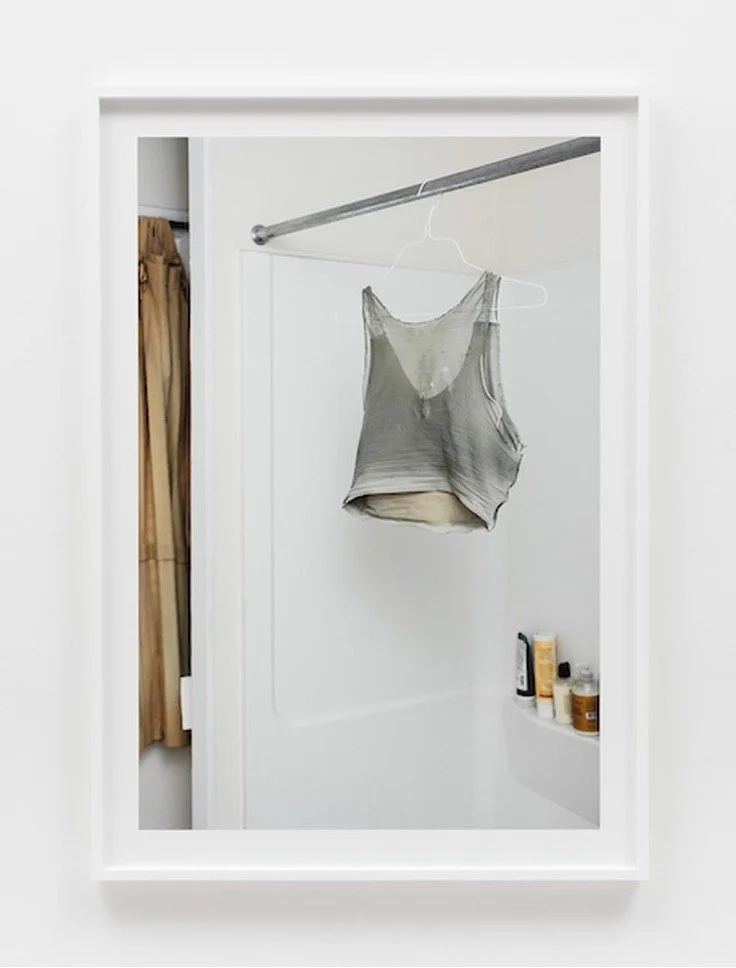
For instance, Elle Pérez’s photograph, Binder, which was displayed at the Brooklyn Art Museum back in 2015 and 2018, displays a very personal subject—a binder. This gender-affirming garment is used by trans and genderqueer individuals to smooth their chest and align their gender expression with their gender identity. On a first glance, the garment appears as nothing more than a worn out and dirtied tank top left hanging in a bathroom rack. Yet, taking into account Pérez’s own trans identity, and the context of this being specifically a “commonly concealed…undergarment” (Brooklyn Museum), the image reveals a profound level of vulnerability.
Every rip and tear of the binder tells the story of the individual who wore it, signaling their need to wear it as often as possible to feel like themself. The binder, then, shows us the owner’s certainty of their identity, as they wore the garment timelessly, until the cloth gained its own character and story. Whereas with no context, the binder might appear to be a forgotten tank hanging from the bathroom, with the full story in mind, we can see that the binder is photographed at such an angle that it appears to be waiting patiently and longingly for its owner. The whiteness of the background, which contrasts against the now grayish hues of the actual top, adds a level of peace to the scene, reflecting the peace that wearing this binder brings to the person using it. Here, time functions as a mediator between the implied trans subject and their identity, allowing them to ease into the garment until it becomes second nature and achieves its worn-out look.
But, how can this photo be considered a portrait, if it doesn’t contain the actual individual who owns the binder? To explore this question, I performed a collage-based material exploration in which I cropped out the shape of the binder and replaced it by gluing the flowers from Gabriela N. Báez’s photo onto the background, filling in the boxy silhouette. This new iteration of the piece highlighted the garment’s vibrant inner life, bringing it to the forefront. It effectively replaced all the scars and tears with colors, hinting at the emotions that the individual wearing it must have felt with it on. I was curious as to whether the actual picture of the binder would feel more like a portrait with a person wearing it. After crumpling it to accentuate its wear, I glued it on top of the head of an individual from Báez’s photo. To my surprise, the binder appeared to lose its character once a clearly defined human was attached to it. The object, then, needed to be isolated from the human body to tell its own story, and to thus become a human-like subject that merits its photo being considered a portrait.
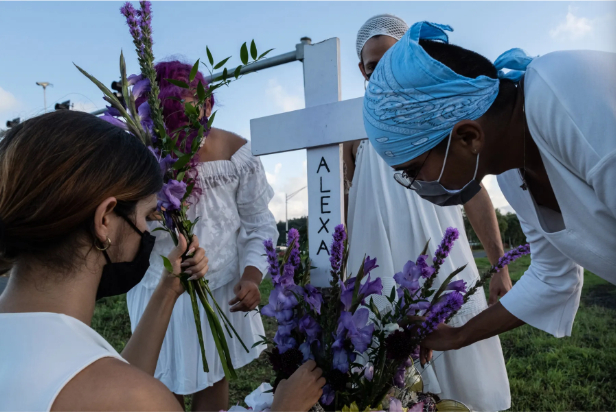
In a similar way, Gabriela N. Báez’s photograph of the grave of late trans woman, Alexa Negrón Luciano, acts as her portrait, despite her not being physically present. The picture, while displaying a moment of communal grief from members of the House of Grace, a queer and trans mutual-aid Puerto Rican artists’ collective (Time), also highlights intense love and care. Indeed, the position of the four individuals surrounding Alexa’s grave, who stand very close to one another wearing white against the light blue sky and the purple flowers, creates a sense of shared love towards Alexa. The photo’s passive frame, which places the cross with Alexa’s name right in the center for the viewer’s eye to behold, allows Alexa to take up the focal point of the scene. In this way, Alexa becomes a presence greater than that which she has been reduced to due to anti-trans violence in Puerto Rico (Time). Unfortunately, as Time notes, “6 trans people [in Puerto Rico] of only 3.1 million were killed in 2020—a devastating toll to begin with, and one that the queer community believes is drastically undercounted.” Even though Alexa is unfortunately part of these statistics, her positioning at the center of the photograph helps her surpass (if only briefly) the hostile conditions that took her life by giving her visibility, and showering her with the love of her community.
To prove that this photo is also a portrait of a queer individual, I went on another material exploration in which I cropped Alexa’s grave and flowers to find out whether the image would lose any impact with her grave’s absence. Unsurprisingly, it did—once the cross with Alexa’s name was removed, a sense of impact was also lost in the remaining photograph. On its own, though, Alexa’s cross still communicated her strong presence, allowing her to live on. Báez’s photograph is therefore a portrait that both sheds light on the intimacy of community care, while also showing the everlasting quality of trans lives that were particularly impactful. Time is thus frozen and subverted in this photograph, as despite no longer being alive, Alexa continues to exude her presence for the viewers of the photograph to notice.
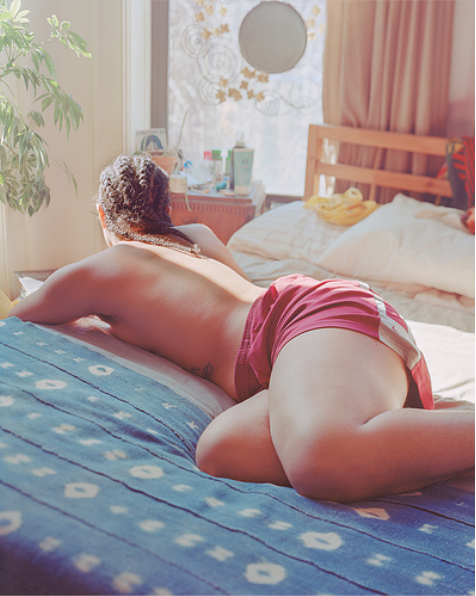
On a different note, Andina Marie Osorio’s photograph of her lover lying on a bed portrays a human subject. However, the interesting part of this piece is Osorio’s deliberate choice to protect her lover’s gaze. As part of i still look for her in every lifetime, which is Osorio’s debut series of photographs depicting queer friends, family, and memory, this interesting portrait questions traditional conceptions of the gaze within photographs. As described by the New York City gallery, HESSE FLATOW, in which Osorio’s work was shown, “[t]he averted gaze, often present in her works, speaks to the erotic potential of the change glance–and act of resistance against the objectification of queer bodies. These works underscore the belief that true understanding of queerness requires a look inward, acknowledging both yearning within and the fact that seeing a figure’s face does not equate with truly knowing them.”
Osorio’s decision to deny the camera the gaze of her subjects is quite powerful, as it goes against what is expected of a photographer. Indeed, portraits are traditionally thought of as depicting the person right from the front to reveal their appearance and personality. Yet, Osorio chooses to conceal the graze because she wants to show that one does not need to be visible to be relatable. This is in line with Édouard Glissant’s theory of “opacity” in his essay “For Opacity,” in which he argued that, “[i]f we examine the process of ‘understanding’ people and ideas from the perspective of Western thought, we discover that its basis is this requirement for transparency. In order to understand and thus accept you, I have to measure your solidity with the ideal scale providing me with ground to make comparisons and, perhaps, judgements. I have to reduce” (189-190). In short—the most normalized and easy way for Westerners to approach understanding those around them is by making them transparent. Yet, like Glissant, Osorio’s pictures prove that a person doesn’t have to be fully visible or comprehensible in order to be relatable. In fact, it is this refusal to bend to societal norms of making a subject transparent that ends up revealing more about them than if they were to be fully identifiable.
Even though her lover isn’t facing the camera, the audience can see her body as it rests peacefully and unabashedly on the comforter. The particularly mellow and bright lighting gives the photo a serene atmosphere that aligns with the overall softness of the colors surrounding the subject. Despite not knowing what this person looks like, viewers can recognize their utter sense of comfort and security in their bare skin. Therefore, the image shows a confident queerness that oscillates between the public and private spheres, as the private becomes public in Osorio’s work without being completely defiled.
To understand the impact of the individual’s presence on the photo, I followed the same procedure as with the other two photographs—I cropped the body out of the background, effectively decontextualizing it. By gluing the remainder of the photo onto a black paper, I noticed how, despite being absent, the figure still felt present due to the silhouette. The attention of the photo, however, now rested on the background, leading potential audiences to wonder how the original body would have related to the surroundings. Yet, the subject isolated still conveyed a sense of serenity and confidence, which supports the idea that this photo is a portrait and an ode to queer confidence.
As a whole, these images underscore that the bounds of portraiture can be blurred and watered to include queer images that, in their unique conceptions of time and space, manage to reveal as much—if not more—about their subjects as traditional portraits. These images hint that, despite being historically overlooked, Puerto Rico’s queer and trans photographers are blossoming in their careers, bringing about queer visibility in very deliberate and calculated ways that pave the way both for further representation, and for a continued questioning of the bounds of traditional photography.
Bibliography
“About.” AndinaMarieOsorio. https://www.andinamarie.com/. Accessed 8 December 2025.
“About.” GabrielaN.Báez. https://www.gabriellanBáez.com/about. Accessed 8 December 2025.
“Andina Marie Osorio - i still look for her in every lifetime.” HESSE FLATOW, 2025, https://hesseflatow.com/exhibitions/137-andina-marie-osorio-i-still-look-for-her-in-every-lifetime/overview/. Accessed 8 December 2025.
Báez, Gabriela N. Untitled. 2021, Toa Baja, Puerto Rico.
Glissant, Édouard. “For Opacity.” Poetics of Relation. Translated by Betsy Wing, 1997, pp. 189-194.
Osorio, Andina Marie. Untitled (i still look for her in every lifetime). 2025, HESSE FLATOW, New York, NY.
Pérez, Elle. Binder. 2015/2018, Brooklyn Museum, New York, NY.
Rosa, Alejandra. “‘Here We Can Express Ourselves With Freedom.’ In Puerto Rico, A Trans Collective Is Reimagining Family Values.” Time, 29 Jun. 2021, https://time.com/6071474/house-of-grace-trans-rights-puerto-rico/.